Syndrome-Trellis Decryption in Code based Post-Quantum Cryptography
summary
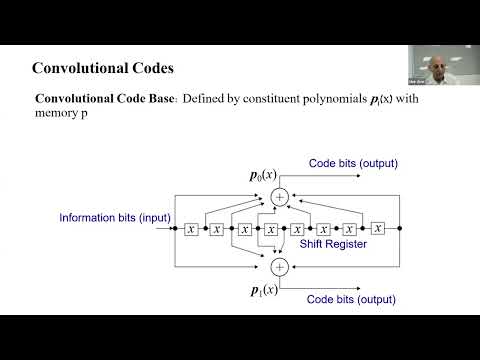
Claims a Niederreiter-style scheme using masked high-memory convolutional codes and a syndrome-trellis decoder that yields polynomial-time decryption while forcing attackers to ISD with estimated work factors about 2^370 (classical) and ~2^185 (quantum). Uses a dense masking matrix, random scrambler and permutation, high-memory polynomial Q of degree ~186 and constituent degree 14, example key n=8200 k=3900, ~574 injected errors at ε≈0.7, and a parallel dynamically instantiated trellis array that the author reports as practical in software and hardware.
AI-written summary · about
chapters (9)
- 0:00Introduction and motivation
- 1:49Code-based cryptography basics
- 4:59Limitations of classic McEliece
- 9:18Convolutional codes and trellises
- 12:57Public and private key architecture
- 17:58Worked encryption and decryption example
- 22:41Security and complexity comparison
- 25:51Performance and implementation
- 26:52Conclusion and contributions