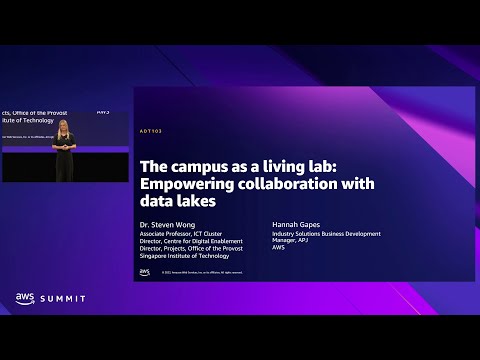
The campus as a living lab: Collaboration with data lakes
summary
University repurposes campus into an active testbed with 20,000 sensors and a private microgrid split into picogrids and nanogrids so concurrent experiments can run without taking operations offline. A cloud-backed living lab uses an AWS-centered stack (including AWS Glue and managed services) to ingest data into a data lake built in six months with a searchable data catalog, role-based access, digital twins and safe actuation paths that let students, faculty and SMEs deploy, test and revert control when needed.
AI-written summary · about
chapters (6)
- 0:00Introduction and welcome
- 1:24About SIT and campus living lab
- 9:59Punggol Digital District vision
- 12:26What is a living lab?
- 23:58Cloud as the living lab operating system
- 37:59Next steps and virtual campus
related talks
 09mLightning Talk: Leveraging Large Scale Data Analytics on Cloud Foundry
 19mThe Design and Operation of CloudLab
 31mVirtual Laboratories Vision for an Earth Sciences
 41mOn Data: Sky above, sand below, peace within
 28mScaling the Future: Lakehouse Architecture and OpenSource Collaboration
 59mModern data lakes with Lake Formation, Amazon Redshift & AWS Glue
 56mUnderstanding and achieving a modern data architecture
 28mTurn Data Into Insights