Latent Effects for Reusable Language Components
summary
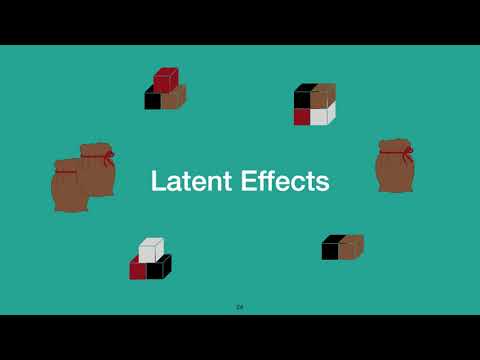
Claims a new class called latent effects that strictly generalizes algebraic and scoped effects and adds a modular latent monad plus a latent functor L to let handlers defer and rearrange meaning. Provides a full Haskell implementation, a composable library of common effects, and worked case studies: a call-by-need evaluator and MetaML-like staging implemented and exercised via composed handlers, showing the approach composes where plain free-monad + handlers could not.
AI-written summary · about
chapters (8)
- 0:00Introduction
- 1:57Reusing generic components
- 3:56Monads for modular limits
- 5:46Data types à la carte
- 7:57Non-algebraic effects challenges
- 9:51Latent effects and handlers
- 13:09Case studies and results
- 14:16Conclusion
related talks
 54mRevisiting the Evolution of Effects (Invited Talk)
 17mHefty Algebras: Modular Elaboration of Higher-Order Algebraic Effects
 15mEffect Handlers, Evidently
 15mZero-Overhead Lexical Effect Handlers
 19mAssociated Effects: Flexible Abstractions for Effectful Programming
 15mEffects as Capabilities: Effect Handlers and Lightweight Effect Polymorphism
 18mLexical Effect Handlers, Directly
 21mCompositions for Free: Reasoning about Effectful Lenses