Camera 2.0: The New Camera Hardware Interface in Android 4.2

summary
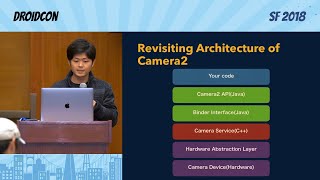
Android 4.2 replaces function calls with a stream-based HAL that exposes per-frame metadata, adds reprocess streams, and lets libcamera service talk to either camera2.h vs camera.h so a device can provide static camera capabilities without opening it. Implementations use V4L2 or OpenMAX, manage memory with a q/dq buffer cycle, and must handle color conversion, buffer sync and interrupts. No SDK APIs appear yet, raw callbacks are rare, and vendors report real work in getting production-quality HALs and minimizing native-to-app copies.
AI-written summary · about
chapters (22)
- 0:00Start
- 3:25Prominent Camera Use Cases
- 5:59Limitations in Camera API
- 8:46Overview of android.hardware.Camera
- 9:36Camera. Parameters
- 11:27the rest of the Camera Classes
- 11:37Camera 2 Internals
- 13:39Hardware Abstraction Layer
- 13:53Camera Subsystem
- 14:18Process View
- 20:49Metadata
- 23:11Camera Stack - Camera HAL
- 24:49Sample JB CameraHAL Functional Diagram
- 29:44Camera Stack - Camera Driver
- 30:04Android Kernel Camera Driver The kernel driver presents a standard interface for different types of camera hardware
- 32:02V4L2 Kernel Driver Block Diagram
- 33:56V4L2 Kernel Driver Resources
- 35:51V4L2 Driver Buffer Management
- 37:02Typical V4L2 Preview Sequence (1)
- 41:01V4L2 Media Controller Architecture(Cont.)
- 42:58Challenges in Camera HAL Development
- 46:41What's coming ?