Introduction to Cancer Bioinformatics III: Cancer Progression Networks

summary
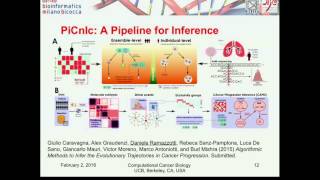
Defines and fits explicit progression models: a restricted Bayesian network (oncogenetic tree) and its generalization (conjunctive Bayesian network) with one parameter per event (θ) and exponential waiting times (λ), handles censoring and noisy calls via a nested EM and an MCMC sampler, and shows it recovers structure on simulated data. Applications: 251 renal CGH cases (12 events) highlight early 3p loss and unexpected 4q loss, pathway-level models are more stable and improve survival prediction.
AI-written summary · about
chapters (26)
- 0:00Cancer progression models
- 1:44Vogelgram: Linear genetic progression
- 3:48Linear progression
- 4:14Phylogenetic vs. oncogenetic models
- 5:56Outline
- 6:52Modeling oncogenesis
- 14:22Tree reconstruction
- 17:16Posets and order ideals
- 21:29Exit sets
- 22:35Conjunctive Bayesian networks (CBN)
- 27:58Individual progression
- 29:45Waiting time distribution
- 33:43Censoring
- 35:36Posets define the geometry of genotype space
- 37:41Hidden conjunctive Bayesian network (H-CBN)
- 41:57Bayesian inference - MCMC sampler
- 42:47Uncertainty: edge-wise posterior
- 43:09Comparative genome hybridization (CGH)
- 43:30Example: Renal cell carcinoma
- 44:41Renal cell carcinoma: survival analysis
- 46:48The genetic progression score (GPS) is a prognostic biomarker
- 47:56Fitness advantage (colorectal cancer)
- 48:06Progression on the level of pathways
- 49:08Example: glioblastoma multiforme
- 49:51Global model of pathway progression
- 50:42Learning pathways and their dependencies simultaneously
related talks
 22mInferring Selective Advantage Relationships to Reconstruct Cancer Progression Models
 39mIdentifying Disease Mechanisms Using Gene Networks as Priors
 44mNetwork Propagation as a Tool for Deciphering Disease Mechanisms
 33mUnderstanding Molecular Complexity for Precision Medicine
 33mNetwork Data Integration Enables Precision Medicine
 01h 24mBayesianism and Survival Analysis
 38mMixed and Covariate-Dependent Graphical Models
 35mFrom cells to drug responses - machine learning in cancer research