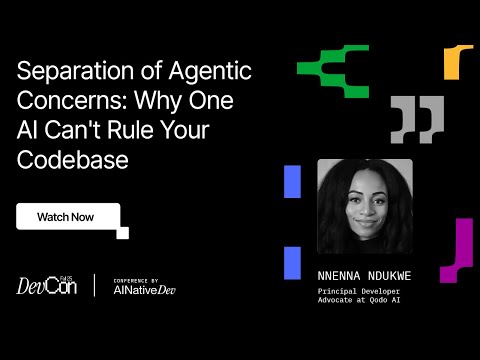
Separation of Agentic Concerns: Why 1 AI Can't Rule Your Codebase
summary
Argues that specialized agents outperform a single generalist AI for real SDLC work, proposing planning, coding, review agents that respectively break down tickets, generate code within guardrails, and enforce quality and style. Recommends a context engine with MCPs and embeddings (Codto/Kodo-style) to index the codebase, learn approvals, and share state across agents. Cites that ~1 in 5 AI suggestions contain functional errors, 44% blame context gaps for degradation and 40% blame inconsistent team standards, and shows how separation reduces duplication and drift.
AI-written summary · about
chapters (9)
- 0:00Introduction
- 1:53One AI to rule them all?
- 6:33Problems with general AI
- 7:37Microservices for AI agents
- 10:14Separation of agentic concerns
- 12:42AI in SDLC phases
- 15:54Context engine side quest
- 19:09Specialized agent phases
- 22:42Why this matters
related talks
 27mAgentic Engineering: Working With AI, Not Just Using It
 29mPairing with the machine: How AI Agents are rewriting the rules of software development
 28mAgentic AI
 22mBuilding Better Software: A New Blueprint for the Agentic SDLC
 51mBeyond Code Generation: Governing AI Agents Across the DevSecOps Lifecycle
 26mAI Agents as Your Co-Developer
 01h 00mKenote: AI Didn’t Replace You. It Promoted You!
 25mFrom AI Chaos to Production Ready: Using AI Agents to Improve Your Code Quality