Fault Tolerance of Stabilizer Channels
summary
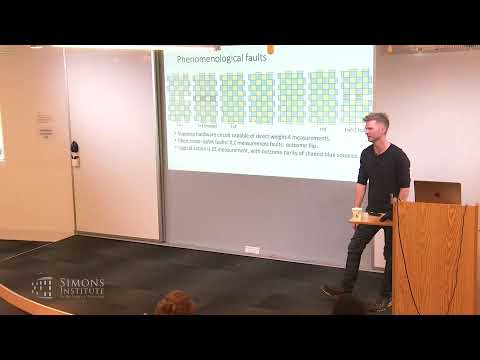
Defines a practical fault distance for stabilizer channels, gives linear-algebra H and L matrices to compute syndrome and logical action, and proves a composition rule so independent verified blocks remain fault tolerant when combined. Introduces brazen and hazardous hooks as the specific circuit faults that drop distance, gives an algorithm (edge‑weight perturbation) to test whether any given fault set sits inside a minimal logical fault, and applies the tools to build and verify a working Hadamard implementation for the surface code (Clifford/stabilizer circuits only).
AI-written summary · about
chapters (12)
- 0:00Fault tolerance blueprints
- 3:54Fault distance tools
- 7:12Stabilizer channels formalism
- 13:54Logical fault effects
- 21:11Calculating fault distance
- 24:02Fault tolerant operations
- 27:42Hook errors in circuits
- 33:47Characterizing problematic faults
- 36:35Hadamard gate design
- 38:46Practical circuit design
- 41:04Threshold theorems
- 50:56Q&A
related talks
 32mFault tolerance with the ZX-calculus and fusion complexes: tools for QEC development in the...
 01h 37mFault-Tolerance Against Adversarial Errors & PCPs
 50mMaking the Leap to Quantum PCPs
 33mA lower bound on the space overhead of fault-tolerant quantum computation
 22mLower Bounds on Stabilizer Rank
 36mCircuit-To-Hamiltonian From Tensor Networks and Fault Tolerance
 45mOn the NLTS Conjecture
 30mHow to fault-tolerantly realize any quantum circuit with local operations