Nonlocal Physics-Informed Neural Networks - A Unified Framework for Nonlocal Models
summary
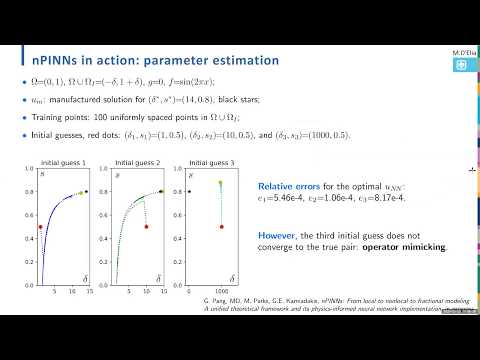
A unified nonlocal calculus and nPINNs use a neural network surrogate for the solution (tanh activations) and optimize weights plus model parameters mu and the interaction radius Delta by minimizing PDE residuals and data misfit. On manufactured tests the learned Delta and fractional exponent s converge to true values from multiple starts and show the same error-vs-training-point scaling as finite-difference baselines. Couette-flow experiments learn a spatially varying s(y) (represented by a second NN), reveal an optimal Delta ≈ 100, and exploit operator mimicking to replace costly fractional (infinite-Delta) models with cheaper finite-Delta ones.
AI-written summary · about
chapters (15)
- 0:00Introduction
- 1:03Nonlocal Models
- 5:14Questions
- 6:12Problem
- 7:15Unified Calculus
- 8:52Nonlocal Operator
- 14:06Properties
- 17:39Operator
- 19:55Operator mimicking
- 23:34Quad flow
- 24:53Two neural networks
- 28:23Delta
- 30:56Diffusion
- 32:03Approximate Model
- 33:03Audience Questions
related talks
 34mData-Driven Solutions in Engineering
 31mScientific Machine Learning With NVIDIA PhysicsNeMo
 50mLearning and Generalization in Over-parametrized Neural Networks, Going Beyond Kernels
 01h 04mNeural Networks meet Nonparametric Regression: Generalization by Weight Decay and Large...
 01h 02mTutorial: Statistical Learning Theory and Neural Networks II
 01h 07mConsensus-Based Interacting Particle Systems and Mean-field PDEs for Optimization and Sampling
 47mInvariance, Geometry and Deep Neural Networks
 01h 14mRecent Developments in Over-parametrized Neural Networks, Part I