Privacy Enhancing Cryptography at NIST

summary
NIST revives a Privacy Enhancing Cryptography project to produce reference implementations and readable standards focused on ZKProof, secure multi‑party computation and private set intersection, with an aim to make primitives usable by non‑expert developers. Work includes critique of a deployed identity hub that exposed attributes (project discontinued 2015), building a 512‑bit public randomness service that emits bits every 30–60s, and prototyping an SMC pipeline for college‑loan ROI across lenders, universities and IRS to demonstrate cost and parameters for adoption.
AI-written summary · about
chapters (10)
- 0:00Intro
- 0:55Crypto Standards at NIST
- 8:00Different approaches to standards
- 10:30Privacy at NIST
- 13:00Privacy Engineering Crypto
- 21:13Identification
- 25:50Deep Protocol
- 33:23Public Randomization
- 36:18Applications
- 36:46Final remarks
related talks
 44mZero-Knowledge Proofs: Simultaneously ensuring integrity and privacy
 19mInnovations in Privacy Technologies: The Keys To Decentralized Networks
 20mThe Evolution of ZKProof.org
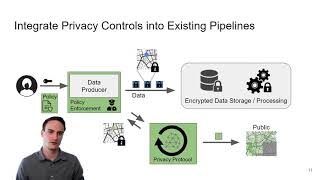 15mZeph: Cryptographic Enforcement of End-to-End Data Privacy
 32mSome useful bits: A few solved development problems via Crypto
 13mSurvey of Privacy Solutions for Minimizing MEV
 32mSoK: Private Programmability on Blockchain Systems
 37mDemystifying Privacy Preserving Computing