Consciousness and Large Language Models
Talkat Understanding Higher-Level Intelligence from AI, Psychology, and Neuroscience Perspectives · 2024-06-24..06-28·
summary
Argues current transformer LLMs lack several plausible consciousness X‑factors—robust self‑models, recurrence, a global workspace and unified agency—though they already have multimodality and basic world models; points to Perceiver IO and neuromorphic neuron replacements as concrete engineering paths and calls for interpretability for mental states. Gives rough numbers: ~10% chance current pure LLMs are conscious using six independent X‑factors, and ~25% chance within 10 years if successors add the missing features. Raises ethical urgency about moral status and legal consequences.
AI-written summary · about
chapters (20)
- 0:00Consciousness and AI intersection
- 1:52Defining consciousness
- 5:55Easy vs hard problems
- 8:47Problem of other minds
- 13:05Behavioral tests for AI
- 15:59Neural markers of consciousness
- 17:07Theories of consciousness
- 21:20Psychophysical laws
- 22:03AI consciousness ethics
- 25:14Language models conscious?
- 28:44Criteria for AI consciousness
- 30:53Probabilities of AI consciousness
- 34:10Biology and consciousness debate
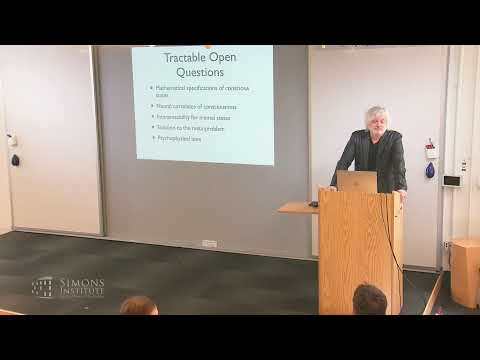
- 36:20Open questions research
- 38:51Conclusion research call
- 39:57Q&A evolutionary theories
- 43:08Q&A biology requirements
- 45:41Q&A global workspace
- 48:37Q&A hard problem abstraction
- 51:28Q&A hard problem replacement
related talks
 35mReading the Mind of an LLM
 51mTowards a Pragmatic Understanding of Large Language Models
 56mMirror, mirror: LLMs and the illusion of humanity
 49mA Practical Approach to Using LLMs: Peculiarities and Pitfalls
 51mLarge Language Models: Friend, Foe, or Otherwise
 21mSentient AI – Can We Create Artificial Consciousness?
 40mIs my Large Language Model a Strange Loop?
 01h 01mBetween the Layers– Interpreting Large Language Models