What Do We Do Now, Now That We’re Happy?
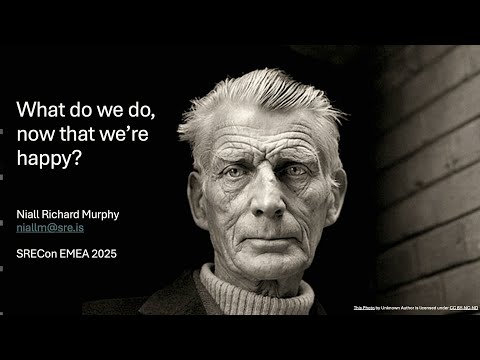
summary
Claims that AI task capability is doubling every seven months and that agents recently solved six of seven IMO problems frame a push to apply models to SRE work, but practical limits matter: the Canat math shows 95% per-step fails after seven trials makes long chains unreliable, Ashby’s requisite variety requires richer control knobs, and Urisco-like failure modes (safe inactivity) occur. Expect more generated code, more bottlenecks and edge cases, concentration of risk on third‑party models, and likely short‑term staffing shifts rather than simple automation wins.
AI-written summary · about
chapters (8)
- 0:00Introduction
- 3:39AI future visions
- 7:09Modeling SRE for AI
- 11:22AI transforming SRE
- 16:00AI progress limits
- 23:08AI in production
- 34:20SREs now that we're happy
- 37:12Closing thoughts
related talks
 36mHow to Get AI to Stop Being Weird and Actually Be Useful
 30mHow AI Agents Will Change Everything (2026)
 20mThe Age of AI Agents
 27mHow to Build AI Agents and Keep Your Sanity
 46mExtreme Programming with AI?
 14m15 Months of building AI agents in 15 minutes
 24mHow AI is increasing the surface area for serendipity
 23mHuman-Driven Intelligence: Where AI & Automation Fall Short