A Distribution Framework over ANSIBLE

summary
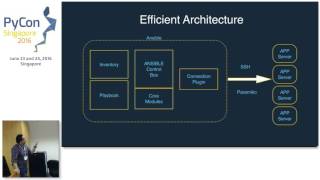
Claims a distributed scheduling layer built on Ansible that scales to tens of thousands of nodes by splitting responsibilities and running many Ansible workers, overcoming the native per-play concurrency ceiling of ~300–500. Architecture uses RabbitMQ + Zookeeper + Celery for queuing, discovery and asynchronous execution, Flask to expose a REST API, Docker to spin worker slaves, and automatic playbook generation; it also modifies Ansible source for parameter validation. Results are pushed back into the messaging queue and the system provides high availability and fast recovery.
AI-written summary · about
chapters (15)
- 0:00Intro
- 1:45Origin of the Word "Ansible"
- 2:16What's Ansible
- 5:05Overview of Ansible
- 6:15Ansible Playbook Sample
- 7:18Issues
- 8:56The Boss of this story
- 9:33Octobot Design Goal
- 10:29Octobot's component
- 12:32Step 1
- 14:20Step 3 - Sample One slave support 400 clients concurrency
- 15:22Step 4
- 17:04Generate Playbook
- 17:31Step 6
- 18:46Everything in Docker
related talks
 28mA tale of Ansible fanboy
 31mPractices to Improve the Performance, Scale and Efficiency of Your Ansible Playbooks
 48mHow We Manage Infrastructure Across 1,000+ Servers Using ansible
 37mAnsible 101
 36mGentle Introduction to Ansible
 46mAnsible for developers
 36mPulling the Puppet Strings with Ansible
 26mOpenHPC on Ansible