The 7 Habits of Highly Successful Samurai, and How That Helps Rubyists
summary
History of Agile starts at Snowbird where 17 people in six hours draft the manifesto and 12 principles; Crystal appears as a claim that success comes from the Crystal 3-step model — practices, principles, personalization — and seven measurable properties: frequent delivery, reflective improvement, close communication, personal safety, focus, access to expert users, and a technical environment (version control, automated tests, continuous integration). Concrete numbers and examples: a 50‑person 1994 industrial project, claims that methodology accounts for ~15% of outcome, and unit tests plus CI are essential to make frequent delivery work.
AI-written summary · about
chapters (14)
- 0:00Start
- 0:26The Agile Manifesto
- 1:46Grounded Research
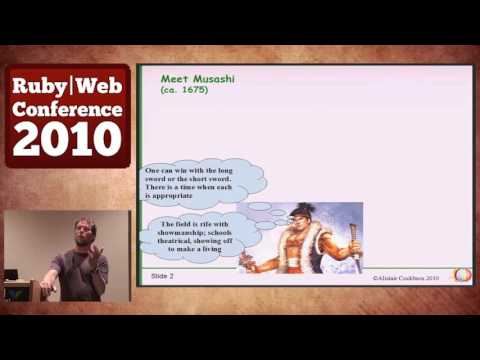
- 10:37Musashi
- 11:19The Book of Five Rings
- 13:45No Wasted Movement
- 19:257 Habits of Highly Successful
- 21:34Four Values in the Manifesto
- 22:01Focus on the Individual People and Their Interactions
- 25:32Personal Safety
- 27:53Focus
- 28:51Version Control Configuration Management
- 32:20Design as Knowledge Acquisition
- 32:49Self-Awareness
related talks
 51mKeynote: Modern Agile
 01h 22mAgile - The Road Towards Organizational Agility - Progress & Challenges Examined
 34mNative Agile Psychology of Teams and Individuals
 26mIs Agile still the answer?
 46mAgile: principles over practices
 42mAgile Crystal: Creating a Process Aimed at Maximum Product Quality
 01h 01mLeadership Lessons from the Agile Manifesto
 30mLeadership Lessons from the Agile Manifesto