Distinct Gene Programs Underpinning ‘Disease Tolerance’ and ‘Resistance’ Against Infections
summary
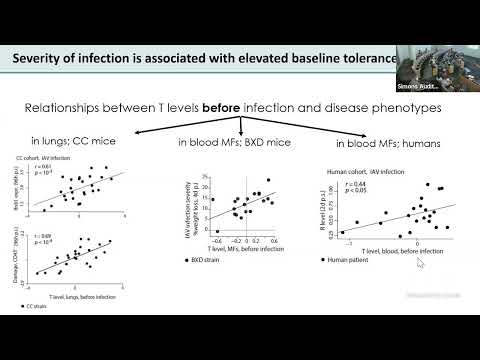
Identifies two co-activated lung gene programs — T program (disease tolerance) and R program (pathogen resistance) — from ~250 samples across 33 CC mouse strains with five time points, using autoencoder-based gene-level dimension reduction. R genes map to interferon/antiviral pathways and track viral burden; T genes map to wound healing/ECM and predict tissue damage per virus. Perturbation of RGDIA affects T-specific responses, T scores before infection predict severity and replicate in BxD mice and human cohorts.
AI-written summary · about
chapters (11)
- 0:00Intro
- 1:35Different individuals show distinct disease outcomes
- 1:48Study design Lung
- 4:29Variation in disease tolerance
- 5:59Two key programs of the host response to IAV infection
- 7:22Scores for the two programs successfully describe a large part of the
- 10:41Two defense strategies: disease tolerance and resistance
- 12:50Evidence 1: Functional analysis
- 16:57Identification of known and putative regulators
- 20:15Acknowledgements
- 22:21Severity of infection is associated with elevated baseline tolerance