Label Noise: Ignorance is Bliss
summary
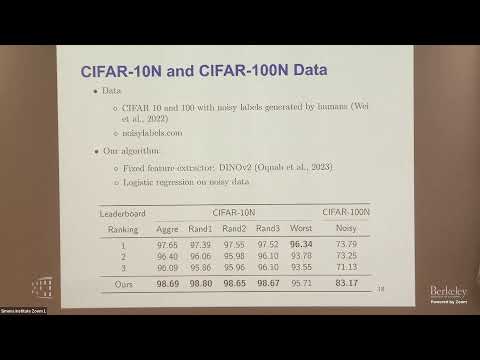
Defines relative signal strength as a pointwise measure of transferability between noisy and clean posteriors and proves matching upper and lower excess-risk bounds under that RSS model, showing an unavoidable epsilon-sized error term where transfer fails. Shows the simple Noise Ignorant Empirical Risk Minimization (NI-ERM) — run ERM on noisy labels as if they were clean — is minimax optimal under these conditions. Practically, fitting a linear classifier on DINOv2 features yields state‑of‑the‑art results on CIFAR-N (despite human label error rates ≈6% on ImageNet).
AI-written summary · about
chapters (11)
- 0:00Introduction
- 2:58Overview
- 9:45Label Noise
- 14:56Signal Strength
- 16:14Relative Signal Strength
- 18:49A Kappa
- 23:26Multiclass
- 24:05Example
- 30:54Theory vs Practice
- 32:50Experimental Results
- 37:56Discussion
related talks
 35mTesting Noise Assumptions of Learning Algorithms
 23mEmbracing Noise- How Data Corruption Can Make Models Smarter
 59mStudying Failure Modes of Deep Learning and Ways To Fix Them
 14mGuarding the Privacy of Label-Only Access to Neural Network Classifiers via Formal(…)
 45mOrthogonal Statistical Learning
 01h 07mLarge-Scale Private Learning, Part II
 43mBeyond Worst Case: When Complex Feedback Can Improve the Label Complexity of Active Learning
 59mTutorial: Statistical Learning Theory and Neural Networks I