The Partition Function, Sampling and Equilibration in Physics
summary
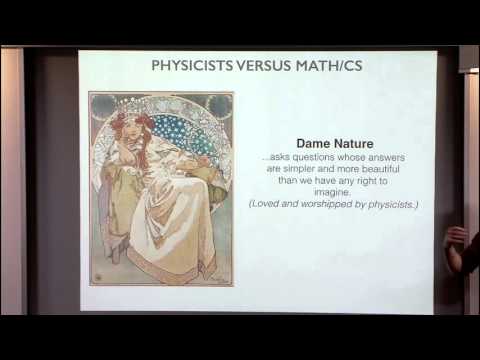
Physicist framing focuses on the free energy as log Z per particle and uses Monte Carlo heuristics to locate sharp phase transitions; empirically mixing time diverges at the dynamical transition (chains become effectively exponential), while a rejection‑free event‑chain algorithm lets simulations reach ~1,000,000 particles and settle the 2D melting debate. For random graph colorings, planted ensembles show an information‑theoretic impossible phase below condensation, a spinodal marking an algorithmic threshold (often around q log q up to q^2), and belief propagation fixed points on tree‑like graphs count clusters and predict sampling hardness.
AI-written summary · about
chapters (20)
- 0:00Intro
- 2:10Statistical Mechanics
- 3:26What do we need
- 8:31Difference between physicists and mathematicians
- 9:50What do physicists do
- 17:08Parallel tampering
- 21:12Detailed Balance
- 23:53How do things melt
- 26:31Respecting global balance
- 27:46Liquid phase coexistence
- 29:30Summary
- 30:20Random graphs
- 33:01Graph coloring
- 34:34Counting colorings
- 36:34Calculating entropy
- 38:23Colorability thresholds
- 40:35Counting and sampling
- 49:30Planted coloring
- 55:05Spinodal transition
- 56:52First order phase transition
related talks
 57mReflection Positivity as Complement to the Location of Zeros of Partition Functions
 50mRandom Combinatorial Matrices
 01h 08mPutting Quantum Supremacy on a Rigorous Footing
 01h 07mPanel with Stephen Wolfram
 01h 01mQuantum Revolution: Through Chaos to Triumph
 23mSome New Results on Random Points in the Unit Square
 30mThe Hitting Proof System
 36mRelative Discrepancy Does Not Separate Information and Communication Complexity